
If you’ve been researching age regression in women, you already know the signs. You may have recognized the childlike emotional responses, the sudden helplessness, the clinging to comfort objects, or the inability to make adult decisions under stress. That self-awareness took courage and it’s the most important first step.
But recognition alone doesn’t create healing. This guide is 100% solution-focused. Below, you will find seven proven, clinically-informed methods to help women overcome emotional age regression, rebuild their adult emotional identity, and finally break free from patterns rooted in old trauma.
Why One-Size-Fits-All Advice Doesn’t Work for Age Regression
Before diving into solutions, one truth must be stated: not every approach works for every woman. Age regression is driven by different root causes childhood trauma, PTSD, chronic stress, attachment wounds and your healing plan should match your specific trigger.
The seven solutions below are organized from foundational daily practices to deep therapeutic interventions, so you can start where you are and build from there.
7 Proven Solutions to Overcome Age Regression in Women

The most effective grounding tools for stopping age regression in the moment:
- 5-4-3-2-1 Sensory Method: Name 5 things you see, 4 you feel, 3 you hear, 2 you smell, 1 you taste
- Cold water on wrists or face activates the dive reflex and calms the vagus nerve
- Slow box breathing: Inhale 4 counts, hold 4, exhale 4, hold 4 repeat 4 cycles
- Stand barefoot on the floor, press your feet down, and state your name and current age aloud
- Hold an ice cube briefly in your palm the sharp sensation redirects the brain to the present
Pro tip: Create a ‘grounding kit’ a small bag with items that engage your five senses. Keep it accessible for moments of regression.

For two weeks, every time you feel yourself regressing or notice regressive emotions rising, record:
- The date, time, and setting where it happened
- What was happening immediately before (conversation, environment, thought)
- What emotion came up and what age it felt like
- How long the episode lasted and what ended it
After two weeks, clear patterns will emerge. You will likely find that 80% of your regression episodes are triggered by just 2–3 recurring situations and those become the focus of your therapeutic work.

A simple daily practice to begin inner child healing on your own:
- Find a quiet space and close your eyes. Visualize yourself at the age you most frequently regress to.
- Speak to that younger version of you with warmth: ‘I see you. You are safe now. I am here and I am not leaving.’
- Ask your inner child what she needed most that she didn’t receive and commit to giving it to your adult self today.
- End by visualizing her taking your hand and walking forward with you into your present life.
Important: This practice can bring up intense emotions. If it feels overwhelming, work with a trauma-informed therapist rather than continuing alone.

The three most evidence-based therapy types for overcoming age regression in women:
EMDR (Eye Movement Desensitization and Reprocessing)
EMDR is widely regarded as one of the most effective treatments for trauma-related age regression. It works by helping the brain reprocess traumatic memories so they lose their emotional charge — meaning present-day triggers no longer send you back to the emotional age of the original wound. Multiple clinical studies confirm its effectiveness for PTSD and trauma recovery.
Trauma-Focused CBT (TF-CBT)
TF-CBT helps women identify the distorted beliefs formed during childhood trauma ‘I am not safe,’ ‘I cannot cope as an adult,’ ‘I need someone to protect me’ and systematically replace them with evidence-based adult reframes. It is particularly effective when age regression is linked to specific cognitive patterns.
Schema Therapy
Schema therapy targets the deep ’emotional schemas’ (core emotional patterns) formed in childhood that drive regressive behavior in adulthood. It directly addresses emotional deprivation schemas, abandonment schemas, and vulnerability schemas all of which are central drivers of female age regression.

Practical steps to build emotional safety:
- Audit your relationships: Identify people or patterns that consistently trigger regression and establish clearer boundaries
- Create a ‘safe space’ at home a specific corner, chair, or room associated only with calm, comfort, and safety
- Develop a daily ritual that anchors your adult identity: morning coffee with journaling, evening walks, structured meals
- Reduce unpredictability in your schedule where possible the adult nervous system regulates better with routine
- Communicate your triggers to trusted people in your support network so they can respond appropriately

Strategies to consciously strengthen your adult identity:
- Daily adult affirmations: ‘I am a capable adult. I can handle what comes. I am safe in my own body.’ (spoken aloud, not just thought)
- Pursue a skill or hobby that builds genuine adult competence and pride
- Practice making and sticking to small daily decisions without seeking reassurance — this builds decision-making confidence
- Celebrate adult accomplishments even small ones to reinforce that your adult self is real, capable, and worth inhabiting
- Maintain consistent physical care: sleep, nutrition, hydration. Regression intensifies dramatically when basic needs are unmet

Your long-term regulation toolkit should include:
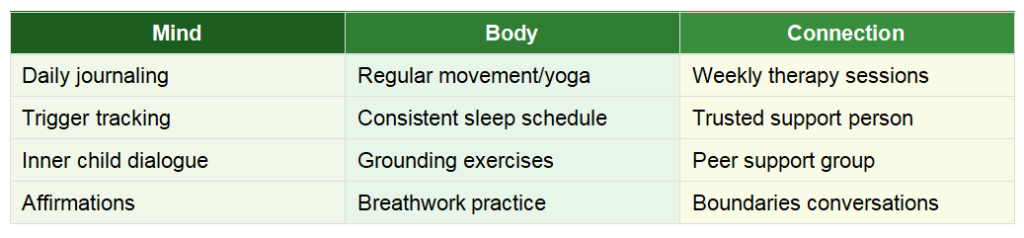
Frequently Asked Questions
Ans: With consistent therapy and self-work, many women significantly reduce or eliminate problematic age regression. The goal is not to eliminate all emotional vulnerability, but to build a stable adult self that no longer involuntarily retreats under stress.
Ans: Timelines vary. Women with mild stress-triggered regression may see meaningful improvement in 6–8 weeks with grounding and journaling. Those with trauma-rooted regression typically see significant change after 3–6 months of consistent therapy.
Ans: For mild cases, self-help strategies like grounding, trigger journaling, and inner child practices can make a meaningful difference. However, for trauma-related age regression, professional therapy particularly EMDR or TF-CBT produces far more reliable and lasting results.
Ans: Look for a trauma-informed therapist with experience in EMDR, inner child work, or schema therapy. Search specifically for clinicians who specialize in women’s trauma, C-PTSD, or dissociative responses.
Ans: Yes that is normal and expected. Regression during therapy often intensifies briefly as buried trauma surfaces. This is a sign the work is happening, not a sign of failure. Your therapist should help you ground and stabilize after sessions.
Ans: Use an immediate grounding technique: name 5 things you can see, press your feet firmly to the floor, take 4 slow breaths, and speak your adult name and age aloud. Text or call a safe person if needed. Regression is temporary your adult self is always still there.
Conclusion: You Are More Than Your Regression
Overcoming age regression in women is one of the most profound healing journeys a woman can undertake — because it is not just about stopping a symptom. It is about finally giving your younger self the safety she always deserved, and your adult self the freedom to live fully.
The seven solutions in this guide from daily grounding to trauma-focused therapy are not quick fixes. They are proven tools that, applied consistently and compassionately, create genuine, lasting transformation.
Start with one step. Pick the strategy that resonates most and practice it this week. Healing does not require perfection only commitment.