The FIFA Women’s World Cup – A Global Phenomenon
The FIFA Women’s World Cup is the most prestigious international women’s football tournament on the planet. Organized by FIFA (Fédération Internationale de Football Association), this spectacular event brings together the best national women’s teams from across the globe every four years to compete for the ultimate prize in women’s football.
Since its inaugural edition in 1991, the Women’s World Cup has grown from a modest 12-team tournament into a massive 32-team competition that commands billions of viewers worldwide. Whether you are a die-hard football fan or a casual observer, the Women’s World Cup delivers an unmatched level of excitement, athleticism, and emotion that transcends sport.
In this comprehensive guide, we cover everything you need to know – from the history of the women’s football championship to upcoming tournament details, top-performing nations, iconic players, prize money breakdown, and FAQs.
The Women’s World Cup showcases not only world-class football but also the growing influence of women in sports and leadership. If you’re interested in celebrating women’s achievements beyond sports, don’t miss our guide on The Stories of American Women:
The Remarkable History of the FIFA Women’s World Cup
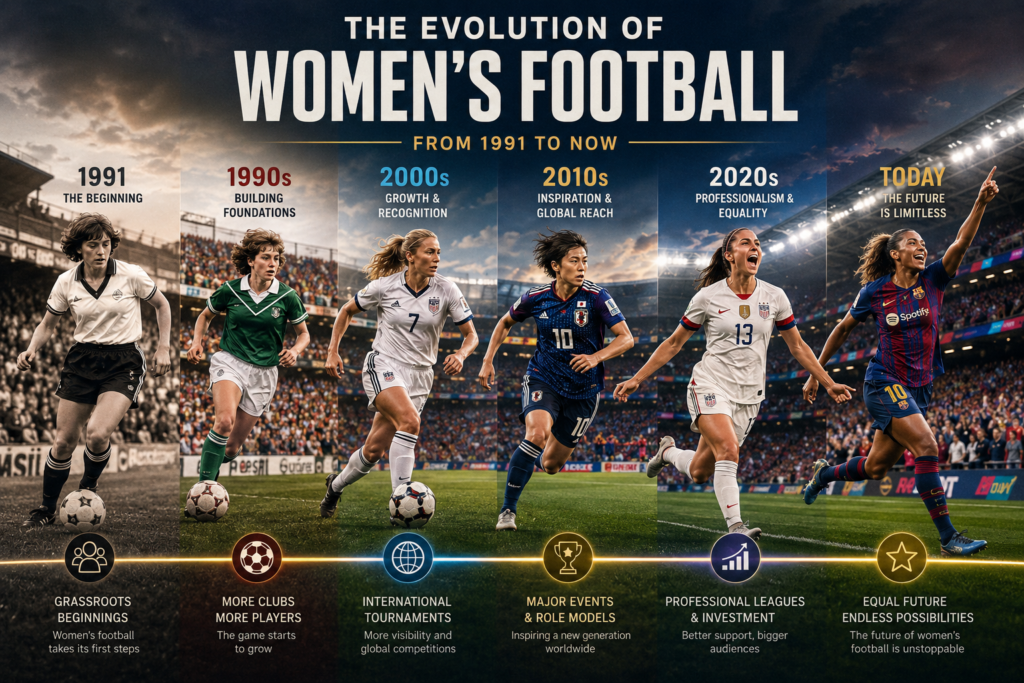
How the Women’s Football Championship Was Born
The journey of the Women’s World Cup began in November 1991 in China, where 12 nations competed in the first-ever edition. The United States claimed the inaugural title, defeating Norway 2–1 in the final – a historic moment that laid the foundation for women’s football on the global stage.
Key milestones in the history of the Women’s World Cup:
- 1991 — First FIFA Women’s World Cup held in China; USA wins
- 1995 — Norway claims the title in Sweden
- 1999 — USA wins again; iconic final at the Rose Bowl draws 90,185 fans — a record for women’s sport at the time
- 2003 — Germany dominates, winning its first title
- 2007 — Germany wins again, becoming back-to-back champions
- 2011 — Japan stuns the world, defeating the USA on penalties
- 2015 — USA wins a record third title in Canada
- 2019 — USA wins a fourth time in France, cementing its dynasty
- 2023 — Spain wins its first-ever title in Australia & New Zealand, defeating England 1–0
Expansion of the Women’s World Cup Format
One of the most exciting developments in women’s football history is the tournament’s expansion. The Women’s World Cup 2023 was the first to feature 32 teams, doubled from the previous 24-team format. This expansion opened the door for more nations from Africa, Asia, and the Americas to participate, making the competition truly global.
FIFA Women’s World Cup 2027 – Everything You Need to Know
Host Nation and Venue Details
The next FIFA World Cup will be held in Brazil in 2027, marking the first time the tournament will be hosted in South America. Brazil’s bid was confirmed by FIFA, and the nation is preparing to welcome teams and fans with world-class stadiums and infrastructure.
- Host Country: Brazil
- Year: 2027
- Format: 32 teams
- Expected Venues: São Paulo, Rio de Janeiro, Brasília, and more
- FIFA Official Website: fifa.com/en/fifaplus/womens-world-cup

Qualification Process for 2027
Teams from six continental confederations will qualify through their respective tournaments:
| Confederation | Allocated Spots (Approx.) |
|---|---|
| UEFA (Europe) | 11 |
| CONMEBOL (South America) | 6 (including host Brazil) |
| CAF (Africa) | 4 |
| AFC (Asia) | 6 |
| CONCACAF (North/Central America) | 6 |
| OFC (Oceania) | 1 |
All-Time Champions of the Women’s World Cup
Which Nation Has Won the Most Titles?
The United States Women’s National Team (USWNT) is by far the most successful nation in World Cup history, having won the tournament four times. Here’s the complete list of champions:
| Year | Host Country | Champion | Runner-Up | Score |
|---|---|---|---|---|
| 1991 | China | USA | Norway | 2–1 |
| 1995 | Sweden | Norway | Germany | 2–0 |
| 1999 | USA | USA | China | 0–0 (5–4 pens) |
| 2003 | USA | Germany | Sweden | 2–1 (aet) |
| 2007 | China | Germany | Brazil | 2–0 |
| 2011 | Germany | Japan | USA | 2–2 (3–1 pens) |
| 2015 | Canada | USA | Japan | 5–2 |
| 2019 | France | USA | Netherlands | 2–0 |
| 2023 | Australia/NZ | Spain | England | 1–0 |
Iconic Players Who Defined Women’s Football
Legends of the FIFA Women’s World Cup
The tournament has produced some of the greatest female athletes in football history. These players have inspired millions of girls around the world to lace up their boots:
- Mia Hamm (USA) — Two-time World Cup winner; once the face of women’s football globally
- Marta (Brazil) — All-time top scorer in Women’s World Cup history with 17 goals
- Birgit Prinz (Germany) — Three-time FIFA World Player of the Year; two-time World Cup champion
- Nadine Angerer (Germany) — World Cup-winning goalkeeper; didn’t concede a single penalty in 2007
- Homare Sawa (Japan) — 2011 Golden Ball and Golden Boot winner
- Alexia Putellas (Spain) — Ballon d’Or winner; led Spain to 2023 glory
These legendary athletes have inspired millions of women to pursue their dreams with confidence and determination. You may also enjoy reading: How Elegant Women Carry Themselves with Grace and Confidence
Rising Stars to Watch in 2027
A new generation of talent is ready to light up women’s football:
- Salma Paralluelo (Spain) — Scored the winner vs. Sweden in 2023 semi-finals
- Trinity Rodman (USA) — Dynamic winger with explosive pace
- Hinata Miyazawa (Japan) — Composed midfield general
- Asisat Oshoala (Nigeria) — Africa’s most feared striker
Prize Money – The Fight for Financial Equality in Women’s Football
How Much Do Players Earn at the Women’s World Cup?
One of the most significant developments in football in recent years has been the dramatic increase in prize money at the World Cup. While the gender pay gap in football remains a talking point, FIFA has made strides toward greater equality.
FIFA Women’s World Cup 2023 Prize Money Breakdown:
| Finish | Prize Money (USD) |
|---|---|
| Champion (Spain) | $10.5 million |
| Runner-Up (England) | $7.5 million |
| Third Place (Sweden) | $6 million |
| Fourth Place (Australia) | $5.5 million |
| Round of 16 exits | $1.5 million |
| Group Stage exits | $1 million |
Total Prize Pool (2023): $150 million — a massive increase from $30 million in 2019.
FIFA has pledged to reach full pay parity between the Men’s and Women’s World Cup in the coming years, a genuinely exciting step forward for the sport.
Impact of the FIFA Women’s World Cup on Global Football
Growing Viewership and Fan Engagement
The FIFA Women’s World Cup has become a commercial and cultural juggernaut. The 2023 edition in Australia and New Zealand shattered records:
- Over 2 billion viewers tuned in globally
- The Spain vs England final was one of the most-watched sporting events of 2023
- Attendance across 64 matches exceeded 1.9 million fans
- Social media engagement reached historic highs, with billions of impressions across platforms
As women’s sports continue to grow worldwide, more women are finding confidence, balance, and healthier lifestyles. Related read:7-Day Meal Plan for Busy Women (2026)
Investment in Women’s Club Football
The success of the Women’s World Cup has directly fueled investment in domestic women’s leagues around the world:
- WSL (England) attracted record sponsorships post-2023
- Liga F (Spain) saw broadcast deals surge after Spain’s triumph
- NWSL (USA) expanded to new cities, riding the women’s football wave
- A-League Women (Australia) gained unprecedented visibility as a co-host nation
How to Watch the FIFA Women’s World Cup
Broadcast Rights and Streaming Platforms
Watching the FIFA Women’s World Cup has never been easier. Here are the key ways to follow every match:
- FIFA+ (free streaming) — FIFA’s official platform offers free live streams in select territories
- BBC & ITV (UK) — Free-to-air coverage for all matches
- FOX Sports (USA) — Primary broadcaster in the United States
- Optus Sport (Australia) — Streaming rights in Australia
- DAZN (multiple regions) — Available across Europe and beyond
Understanding Women’s Football Terminology
Key Terms Every Fan Should Know
To fully appreciate the FIFA Women’s World Cup, here are some essential LSI keywords and terms that frequently appear in coverage of the football championship:
- Women’s football — The broader sport; also called “soccer” in North America
- Women’s World Cup history — The documented progression of the tournament since 1991
- FIFA rankings women’s football — The official FIFA ranking system for national women’s teams
- Women’s soccer tournament — An umbrella term for competitive women’s football events
- USWNT — United States Women’s National Team; most decorated World Cup side
- UEFA Women’s Championship — The European equivalent; a key qualifying stepping stone
- Golden Boot — Awarded to the tournament’s top scorer
- Golden Ball — Awarded to the best player of the tournament
- Golden Glove — Awarded to the best goalkeeper
- VAR (Video Assistant Referee) — Technology used to review match decisions

Frequently Asked Questions (FAQs)
The FIFA Women’s World Cup began in 1991, hosted by China. The United States won the inaugural tournament.
The United States Women’s National Team (USWNT) has won the most titles with 4 championships (1991, 1999, 2015, 2019).
The 2027 FIFA Women’s World Cup will be hosted by Brazil, marking South America’s first-ever hosting of the tournament.
Since 2023, 32 teams compete in the Women’s World Cup, expanded from the previous 24-team format.
Marta of Brazil holds the record for the most goals in Women’s World Cup history with 17 goals across multiple tournaments.
Spain received $10.5 million USD as the 2023 FIFA Women’s World Cup champions, from a total prize pool of $150 million.
In many countries, FIFA+ offers free streaming of Women’s World Cup matches. Availability depends on your region.
The FIFA Women’s World Cup Is Just Getting Started
The FIFA Women’s World Cup is far more than a football tournament – it is a global movement that empowers women, breaks barriers, and inspires future generations of athletes. With the 2027 edition set to captivate South America and a world audience, the tournament shows no signs of slowing down.
From the legendary dominance of the USWNT to Spain’s stunning 2023 triumph, women’s football has given us unforgettable moments, iconic players, and a compelling story of growth. Whether you’re watching for the first time or are a seasoned fan, the Women’s World Cup will continue to deliver drama, passion, and world-class football on the grandest stage of all.
Stay updated by following FIFA’s official Women’s World Cup page for the latest news, fixtures, and player updates as we count down to Brazil 2027.
for more global insights explore our website https://shesimplifies.com/